Showing posts with label Cancer. Show all posts

Monday, 7 April 2008

All You Need To Know About Colon Cancer


Colon cancer is a type of cancer that affects the colon, rectum and appendix areas. Also called colorectal or large bowel cancer, it ranks no. 3 among the common forms of cancers. As much as 655,500 people die from colon cancer around the world every year, making it second among other types of cancers in terms of mortality rate.

Like all types of cancers, colon cancer is caused by abnormal and uncontrolled cell division within the body particularly in the colon and rectum area. There are suggestions that colon cancer is caused by adenomatous polyps that can be found in the colon area, organisms which are originally benign but can potentially become malignant over time.

Possible Causes of Colon Cancer

A diet that is high in fat is thought to be one of the possible causes of colon cancer among people. Doctors theorize that carcinogens are developed through the breakdown of fat metabolism in high-fat diets. It is noted that countries that have high occurrence rates of colorectal cancer have diets that are loaded with fat. That is why the western part of the world have a higher occurrence rate compared to the people in Asia.

Another theory regarding the development of cancer is the presence of benign colon polyps. These polyps are created when chromosomes are damaged in the inner lining of the colon. Since chromosomes are known to control the growth of cells, damaged chromosomes can cause uncontrollable growth and division which are believed to be the origin of cancer. Because polyps are born out of damaged chromosomes, it is linked to the development of colon cancer.

Ulcerative colitis is also pointed as a possible origin of cancer of the colon. Ulcerative colitis is described as an enlargement of the large intestine, and is thought to develop into colon cancer when they become complicated. When a person has ulcerative colitis for eight to ten years, he or she is more at risk of developing colon cancer.

A person’s risk of contracting colon cancer increases as a person gets older. In fact, most people that contract colon cancers are in the 60 and 70 age groups. There are less occurrences in the age groups of 50 and below.

Symptoms of Colon Cancer

Similar to other forms of cancer, colorectal cancer does not manifest any sort of symptoms in its earlier levels making it difficult to diagnose and treat. However, when it develops into more malignant states, sufferers of colon cancer start to feel certain symptoms.

Some organizations propose that people undergo periodic screening for colon cancer using fecal occult blood testing and colonoscopy. These are some symptoms that warrant testing for possible colorectal cancer:

1.Abrupt change in bowel habits including frequency, as well as consistency and quality of stools.
2.Presence of blood in stools.
3.Presence of mucus in stools.
4.Defecation may feel incomplete after you finish.
5.A rare occurrence of obstruction in the bowels.

Anemia, anorexia, asthenia and unexplained weight loss are considered constitutional symptoms of colon cancer.

Sunday, 24 February 2008

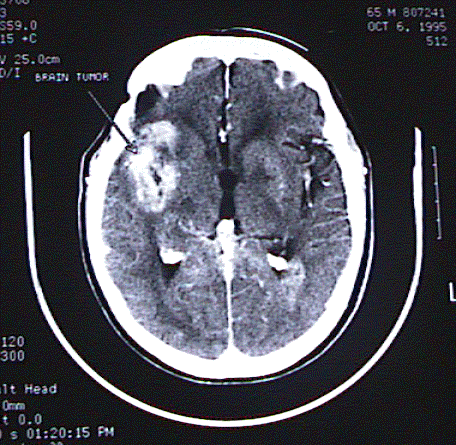
Brain Tumor - Causes, Symptoms, Diagnosis and Treatment


The growth of abnormal cells in the tissues of the brain. Brain tumors can be benign (non-cancerous) or malignant (cancerous).

Brain tumors are classified depending on the exact site of the tumor, the type of tissue involved, benign or malignant tendencies of the tumor, and other factors. Primary brain tumors can arise from the brain cells, the meninges (membranes around the brain), nerves, or glands.

Causes of Brain Tumor

The cause of primary brain tumors is unknown. This is because they are rare, there are many types, and there are many possible risk factors that could play a role. Exposure to some types of radiation, head injuries, and hormone replacement therapy may be risk factors, as well as many others. The risk of using cell phones is hotly debated.
Genetic mutations and deletions of tumor suppressor genes (i.e., genes that suppress the development of malignant cells) increase the risk for some types of brain cancer. Inherited diseases that are associated with brain tumors include the following:

• Multiple endocrine neoplasia type 1 (pituitary adenoma)
• Neurofibromatosis type 2 (brain and spinal cord tumors)
• Retinoblastoma (malignant retinal glioma)
• Tuberous sclerosis (primary brain tumors)
• Von Hippel-Lindau disease (retinal tumor, CNS tumors)

Signs and Symptoms of Brain Tumor

Signs and symptoms can include the following:
• New onset or change in pattern of headaches
• Headaches that gradually become more frequent and more severe
• Unexplained nausea or vomiting
• Vision problems, such as blurred vision, double vision or loss of peripheral vision
• Gradual loss of sensation or movement in an arm or a leg
• Difficulty with balance
• Speech difficulties
• Confusion in everyday matter.

Diagnosis

Computed tomography (CT Scan): A computerized x-ray machine is used to take a series of detailed pictures from many different angles. Dye may be injected to help to clarify organs and tissues.
Magnetic Resonance Imaging (MRI): Powerful magnets waves are used to make a series of detailed pictures. Patients are injected with a substance called gadolinium to highlight possible cancer cells.
Angiogram. This imaging test uses a dye to visualize all the blood vessels in the brain to detect certain types of tumors.

Lumbar puncture/spinal tap. For this procedure, a special needle is placed into the lower back and into the spinal canal around the spinal cord. A small amount of cerebrospinal fluid, which surrounds the brain and spinal cord, can be removed and sent for testing.

Treatment

Surgery is required to determine whether a brain tumor exists and what type of tumor it is. A small sample of tumor tissue may be surgically removed and examined under a microscope. This is called a biopsy. Sometimes a biopsy is done by making a small hole in the skull and using a needle to extract a sample of the tumor.

Radiation therapy is a cancer treatment that uses high-energy x-rays or other types of radiation to kill cancer cells. There are two types of radiation therapy. External radiation therapy uses a machine outside the body to send radiation toward the cancer. Internal radiation therapy uses a radioactive substance sealed in needles, seeds, wires, or catheters that are placed directly into or near the cancer. The way the radiation therapy is given depends on the type and stage of the cancer being treated.

Tuesday, 20 November 2007

5 Important Prostate Cancer Tests That You Should Know About


The mere mention of prostate cancer cause cause a panic in many men. The truth of the matter is though that just like any other cancer, if detected early, your chances of successful treatment of prostate cancer are very high. However, if you allow the cancer to grow too much, it can become very difficult to treat -- in some cases impossible. Because your risk of prostate cancer development increases dramatically after the age of 50, it is crucial that men in this age group get regular checkups and health exams.

Although prostate cancer screening is not considered a routine procedure, you can get tested with a simple request. Regular screening is very important for the following reasons:

1. After the age of 50, your risk of prostate cancer increases substantially. Your risk generally continues to increase as you grow older. After 75 years of age, the risk increases even more. Approximately 50% of prostate cancer cases are diagnosed after the age of 75.

2. It is also likely that genetics play a large role in determining your risk of prostate cancer. If you have a family history of the disease, your chances of developing prostate cancer increase. There are also particular racial groups that are known to contract the disease more often than others. Asians usually have the lowest risk, with Europeans and African-Americans having higher risk, respectively. It is also suspected that lifestyle plays a large part in your risk, because if you are Asian but live in the United States for an extended period of time, your risk of prostate cancer starts to approach the same level as other Caucasian Americans.

Prostate Cancer Tests

There are a variety of tests that are used to detect the presence of prostate cancer. Your physician will often conduct more than one test before coming to a definitive answer. A diagnosis is more reliable after a number of different tests have been performed.

The Rectal Examination

Laughed at by many people, this test involves the insertion of a gloved and lubricated finger into a patient's rectum in order to feel the size and shape of the prostate gland. This is effective for the detection of an enlarged prostate, but be aware that an enlarged prostate does not always signify prostate cancer. However, this is one of the easier and quicker ways of detecting some of the symptoms of prostate cancer.

Ultrasound

This involves the insertion of a small probe into a patient's rectum. After an ultrasound scan is conducted on the prostate, it reveals the current shape and size of the gland.

PSA Blood Test

The Prostate Specific Antigen (PSA) blood test is a common test used for detection. The presence of prostate cancer is inferred from higher than normal levels of this specific antigen found in the blood. However, this procedure should be included with other testing methods as well, since other conditions can result in high PSA levels.

Biopsy

If there is a reason to be concerned, a biopsy of the prostate gland may be conducted. This procedure is undertaken by taking a small sample from the prostate for analysis. This occurs by inserting a small needle into the prostate with the use of a small probe.

X-Ray

An x-ray of the bones surrounding the prostate may also be taken if cancer is detected. Prostate cancer very often spreads to the lymph nodes and bones. If any damage has been done to bones nearby, an x-ray will be able to determine if the cancer has spread.

Are you looking for information about prostate cancer tests? For more important information on prostate cancer, the prostate gland, and prostate cancer prevention and treatments, please visit http://www.onlineprostatehealth.com for more information.

Saturday, 25 August 2007

Easy Steps to Prevent Mesothelioma


Mesothelioma is a rare cancer that attacks the body's mesothelial cells around the organs. The mesothelium provides a protective membranous lining for the internal organs and allows moving organs (i.e. the heart and the lungs) to glide easily against adjacent structures. The names of the three regions of mesothelial cells that provide protective coating are 1) pleura, the sac which surrounds the lungs; 2) peritoneum, the lining which protects the abdominal cavity; and 3) pericardium, the sac which surrounds the heart. Three different types of mesothelioma cancer attack these three different regions.
Pleural mesothelioma: A type of lung cancer which attacks the pleura surrounding the lungs, this is the most common type of mesothelioma, affecting approximately two-thirds of all mesothelioma patients. Symptoms include horseness, fever, blood in sputum, swollen arms and face, coughing, loss of weight, difficulty breathing, chest pain, weak muscles, and reduced tactile sensitivity.
Peritoneal mesothelioma: A cancer of the abdomen which attacks the peritoneum lining the abdominal cavity. This affects approximately one-third of all mesothelioma patients. Symptoms include abdominal bloating, impaired bowl function, fever, swollen feet, and nausea.
Pericardial mesothelioma: This form of mesothelioma which attacks the pericardium surrounding the heart is extremely rare. Symptoms include chest pain, dyspnea, cough, and palpitations.
Mesothelioma has been linked to asbestos exposure. Asbestos is a type of building material used in thermal insulation products and ceiling tiles. In the United States, asbestos usage peaked during the 1950s - 1970s. During the late 1960s, concerns over the health consequences of asbestos exposure began to arise, thereby decreasing the amount of asbestos manufactured in next two decades. By the 1980s, a new industry of asbestos abatement began to flourish. But according to the United States Environmental Protection Agency (EPA), as many as 733,000 schools and public buildings still contain asbestos.
Small asbestos fibers that enter the air do not evaporate and can remain suspended in the air for a long time. These fibers, when breathed into the body, are toxic. There are three types of asbestos exposure.
Occupational asbestos exposure: People working in factories that manufacure asbestos are likely to have a high exposure to asbestos and are most at risk of developing asbestosis or mesothelioma.
Paraoccupational asbestos exposure: Family members of workers exposed to asbestos in the workplace are susceptible to exposure from asbestos dust brought home by the worker on his clothes or skin.
Neighborhood asbestos exposure: Those who live in the vicinity of an asbestos manufacturing plant are also at risk.
Mesothelioma is still a relatively rare form of cancer. There are an estimated 2,000 - 3,000 new cases per year in the United States. Approximately 7-13 per one million male patients with a history of asbestos exposure contract mesothelioma. Diagnosis usually occurs 20-40 years after initial exposure to asbestos.